I never say it without a smile, “I’m living in dog years,” and I’m the first to say it’s not lost on me that I’m living on borrowed time. The diagnosis spoken over me came also with a projected expiration date, but what those doctors may not have known is that my life belongs to God, and he will have me here for the perfect amount of days, regardless of any curse spoken over my life.
Some days a long goodbye comes with torment; an aching to be done with all the hard parts, a desperation for deep and restorative rest. Most days though, I stick to my belief that a prolonged goodbye is a gift entrusted to me by God—a sacred window of time to point a captive audience toward His goodness, faithfulness, and grace.
Over the years, I’ve learned that living in this tension—between the exhaustion of the body and the eagerness of the spirit—is where the real ministry happens. It strips away the frivolous noise of the world and leaves behind a sharp, beautiful clarity: every breath is an intentional choice, every morning a deliberate mercy, and every conversation an opportunity to leave behind an echo of eternity.
A sudden departure leaves little time for final words, but a slow walk home gives you the space to write love letters with your life. It allows you to wrap your arms tighter around those you love, to forgive faster, to laugh freer, and to speak the name of Jesus with an urgency that only a ticking clock can forge. It lets you demonstrate that peace isn’t the absence of pain or the presence of a clean bill of health; it is the unwavering presence of God in the middle of the storm.
I don’t know how many pages are left in my story, and truth be told, I don’t need to. The Author of life has never miscalculated a single chapter. So on the hard days, I will lean heavily on His strength to carry me through the pain. And on the good days, I will use whatever breath I have left to remind anyone listening that death has lost its sting, grace is entirely sufficient, and the God who holds my tomorrows is worthy of every single praise I have left to give.
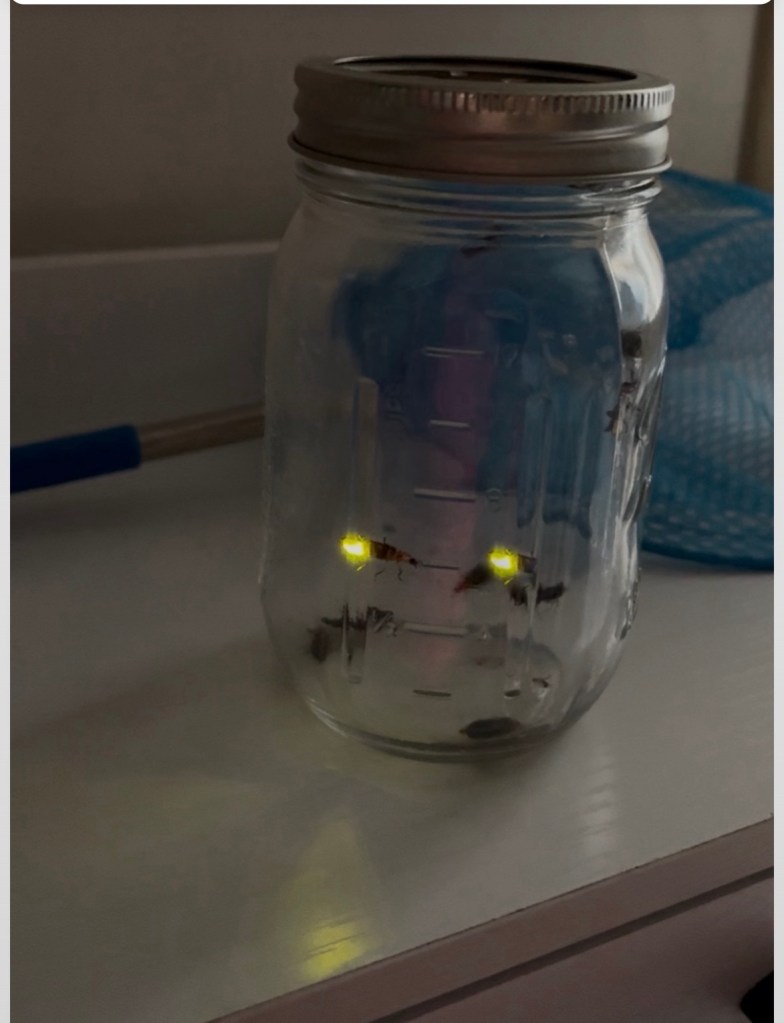
There is a friend who sticks closer than a brother. And then there is a friend who will drive 20 minutes at 10:00pm to press into your hand a jar with two potentially slightly smooshed fireflies that she probably caught while barefoot in the yard her pajamas, but she listened to you bare your soul that day, and she knew that’s all you needed to keep going right now— two, tiny, flickering lanterns to remind you that the dark doesn’t win. Not today.
They weren’t spectacular. They weren’t a grand, sweeping gesture that would make waves on social media. They were just two bugs in a repurposed canning jar, their rhythm a little frantic, casting a faint, irregular glow against the dashboard of her car.
But as she handed them over, her hair still tangled from the evening wind, it hit me: This is what real love looks like.
We live in a world that thrives on “let me know if you need anything” text messages—well-meaning, but safely tucked behind a screen. We have become experts at offering passive support. But a firefly friend? A firefly friend doesn’t wait for an invitation to the tragedy. They don’t need a clean house, a put-together version of you, or even a logical explanation for why your world is tilting on its axis.
They just show up. Even if it’s late. Even if they’re in their pajamas. Even if all they have to offer is a fragile, fleeting piece of light they chased down in the dark just for you.
When you bare your soul to someone, you hand them your vulnerability. It’s terrifying. You wonder if you’ve said too much, if you’ve become a burden, or if they’re secretly judging the mess. But the right people don’t look at your broken pieces and see a chore. They see an opportunity to hold the flashlight while you figure out how to put things back together.
Last night, those two slightly smooshed fireflies told me three things I desperately needed to hear:
1. “I listened.” My friend didn’t just hear my words; she felt the weight behind them.
2. “You are worth the effort.” Worth the drive, worth the mosquito bites, worth the interruption to her night, a night that if we are being honest, SHE should have been the one in bed early having gifts dropped by!
3. “You are not alone in the dark.”
If you are lucky enough to have a friend like this, pull them close. Thank them. Let them know that their messy, barefoot magic saved you. And if you’re sitting there wondering where your firefly friend is, maybe this is your invitation to be one. Look around your circle today. Who is sitting in the dark? Who just bared their soul?
You don’t need a grand plan, a perfect speech, or a pristine gift wrapped in a bow. Sometimes, all it takes is a willingness to run out into your own yard, catch whatever little bit of light you can find, and bring it straight to their door.
Because at the end of the day, we aren’t the source of the light anyway—we are just the ones called to carry it.
When God asks us to love our neighbors, He doesn’t ask for a flawless production. He asks for a willing heart. He takes our smallest, messy, “yard-caught” efforts and multiplies them by His grace.
So if you’ve been waiting until you have it all figured out, or until your offering feels “good enough,” take a deep breath and let that pressure go. Step out into the dark, trust the One who commands the stars, and go share the flicker you have. You might be surprised by just how brightly God can shine through the cracks of your ordinary, beautiful obedience.
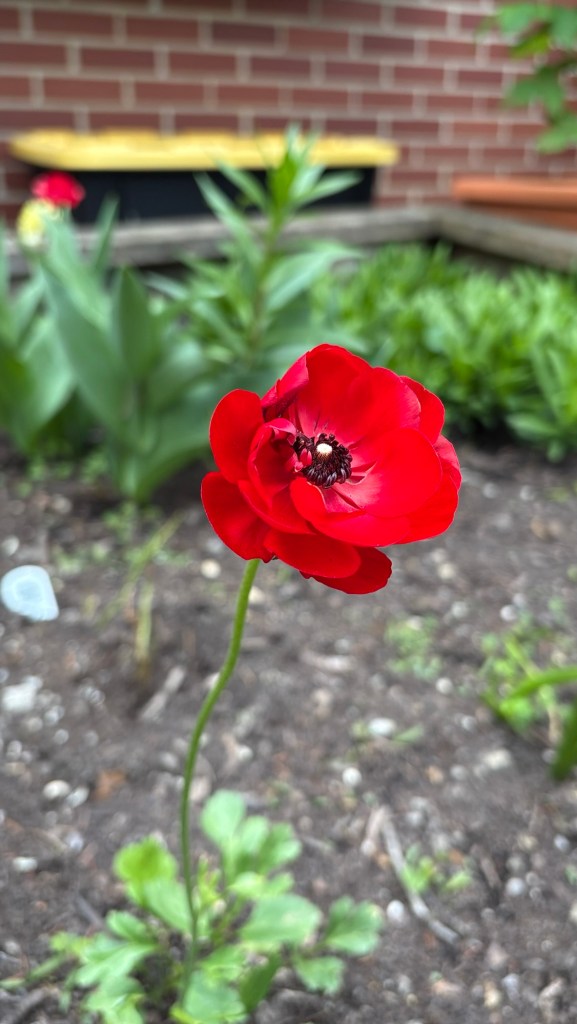
My dresser drawers are an awkward level of stuffed right now. You see, the calendar says we are between Spring and Summer— the time of year when the temps warm up to a delightful cozy warm, but still cool enough to enjoy being outside without your face melting. This year however, we seem locked into some eternal cold front of a winter that is reluctant to release its grip. So I have all my cozy cool weather clothes, but there have also been handfuls of days warm enough to unpack some short sleeves and other summer clothes, so slowly my dresser has become a mish mash of three different seasons. My shoe basket is piled high with a mashup of boots, flip flops, baseball caps, and beanies, lending no real clarity to which season we are actually in.
And honestly, I think my heart has looked a lot like my dresser lately—a strange mixture of seasons all occupying the same space at the same time.
There are things in my life right now that feel deeply good. Prayers being answered. Unexpected joy. Moments that make me laugh so hard I forget, for a second, how heavy life can be. There are relationships growing, little victories worth celebrating, reminders of God’s kindness showing up in ordinary places.
And yet, folded right beside those things are grief, uncertainty, exhaustion, disappointment, and questions I still don’t have answers to.
I keep wanting to organize it all neatly. To separate the winter from the summer. To decide whether this season is hard or beautiful. Joyful or painful. Hopeful or heartbreaking. But life rarely fits into tidy drawers.
Scripture is full of people holding both. The Israelites carried promised land hope while still wandering in wilderness dust. David wrote songs of praise with tears still wet on his face. Martha confessed deep belief in Jesus while standing beside her brother’s grave. Even Jesus, on the night before the cross, broke bread with His friends while fully aware of the suffering ahead.
Faith was never pretending one season didn’t exist. Faith is trusting God enough to hold all of it honestly.
Maybe maturity in Christ looks less like “finally getting to the good part” and more like learning that God is present in every part. In the celebrations and the sorrow. In the healing and the waiting. In the warmth of summer days and the lingering chill that refuses to leave.
Maybe the goal is not to force our lives into one season at a time, but to recognize that sometimes God grows things in the tension of both.
So for now, my drawers remain overstuffed and confused. My shoe basket still looks ridiculous. And my heart still carries both gratitude and grief at the exact same time.But I’m learning this; the coexistence of joy and pain does not mean God is absent. Sometimes it is the clearest evidence that He is gently teaching us how to become people who can hold both hope and heartbreak without letting either one define us completely.
And maybe that messy middle place — where winter and summer overlap — is holy ground after all.
As my illness has not so quietly crept into new areas, the clear, trustworthiness of my world that was semi-predictable has faded as well. Despite what my energetic heart and mind have had planned, my body is simply not getting the message, often doing the opposite of what I’m asking it to. This was especially evident this past week.
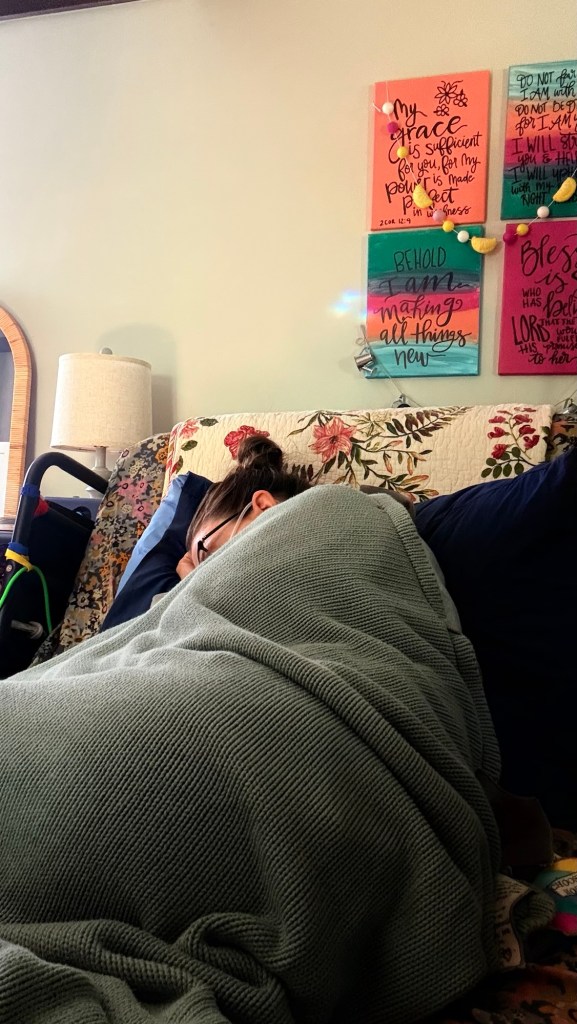
Sunday I slept through most of the sermon and parts of worship. Again. It had been a tiring week—being in the middle of a 2 week stretch where my husband was traveling, but I honestly felt like I got a decent night’s sleep on Saturday. My fatigue continued though, and I found myself either missing things, or having to cancel plans because my body was determined to sleep more whether or not I was at an event or behind the wheel.
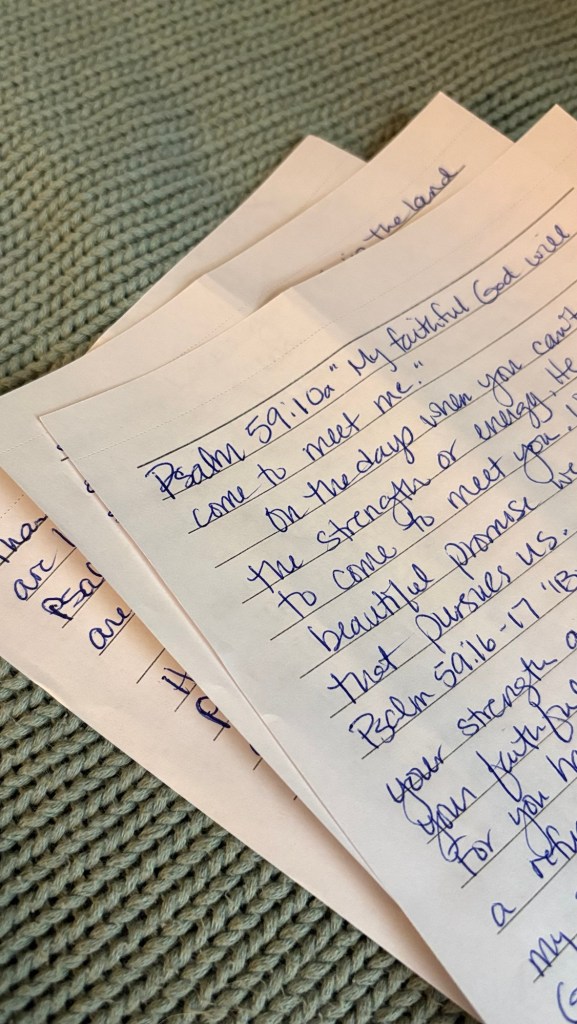
Tuesday a dear friend came over to visit. After just a few minutes chatting I dozed right off mid conversation . I jostled awake shortly, and profusely apologized for my rudeness. My friend was as gracious as could be. The next thing I knew I awoke a significant time later to my friend still sitting at my bedside. She had brought her Bible, and as she read she took notes that she compiled into a beautiful and encouraging 3 page letter that she gifted to me on her way out. I was sad and upset that I had missed out on visiting with her, but her words were a gift to my heart.
“Please don’t be embarrassed. It was an honor you let me in today and I enjoyed the time by your side even if it was a quieter visit. Love you!”
I had another friend visit recently with her kids in tow. The littles sat at the dining table and kept busy while their mama and I visited. I didn’t even realize I was sleepy until I startled awake to see her hustling her littles quietly out the front door.
That moment sat heavy with me long after the door shut. Not because she was unkind—she wasn’t. She was trying to be considerate. Trying not to embarrass me. Trying not to wake me. But what I woke with was the reality of it all. The quietness of it. The careful escape. The unspoken understanding that the visit had suddenly become awkward and there was no graceful way to recover it.
Illness has a way of turning normal interactions into strange little social negotiations nobody knows how to navigate. That may be one of the loneliest parts of this illness for me lately—not just the symptoms themselves, but the way they alter the atmosphere in a room. The way people start adjusting around me. Whispering around me. Watching me carefully. Exiting cautiously.
I know the people who love me are doing their best. I know they aren’t judging me cruelly. But it is still difficult to repeatedly become the unexpected thing everyone has to accommodate. I miss being easy to be around.
My friend who stayed while I slept gave me a gift I didn’t even know I needed; the gift of presence.
Not fixing. Not rescuing. Not trying to force the moment to be less uncomfortable than it was. Just staying.
There is something profoundly Christlike about that kind of love. The kind that does not flee weakness or rush past suffering, but settles beside it without demanding it hurry up and become easier.
I think so often I have imagined God’s love primarily through the lens of intervention—that if He loved me, surely He would fix this. Relieve this. Wake me up from this exhausting fog my body keeps pulling me into. But lately I am beginning to wonder if sometimes His love looks less like removal and more like companionship. A God who remains.
A God who is not embarrassed by my limitations. Not irritated by my weakness. Not awkwardly slipping out the front door because He doesn’t know what to do with me.A God who stays at the bedside.
Maybe that is why the presence of faithful friends has ministered to me so deeply in this season. Because every quiet act of patience, every unhurried moment, every person willing to sit in the strangeness of this illness without recoiling from it—they are reflecting Him back to me in ways I desperately need.
Not every act of love looks dramatic. Sometimes holiness looks like simply staying when it would be easier to leave.
There was a time when they were the new couple. The friendly girl, not afraid to take on a bleak prognosis, and her wingman, always at her side helping her along.
Then things started to change. The wingman was often tied up elsewhere, and eventually wasn’t available to pursue the same life she did, so she continued showing up on her own, often with a kid or two in tow. And then that dwindled too, the kids stopped wanting to get up on Sunday mornings, pushing back against beliefs they once embraced.
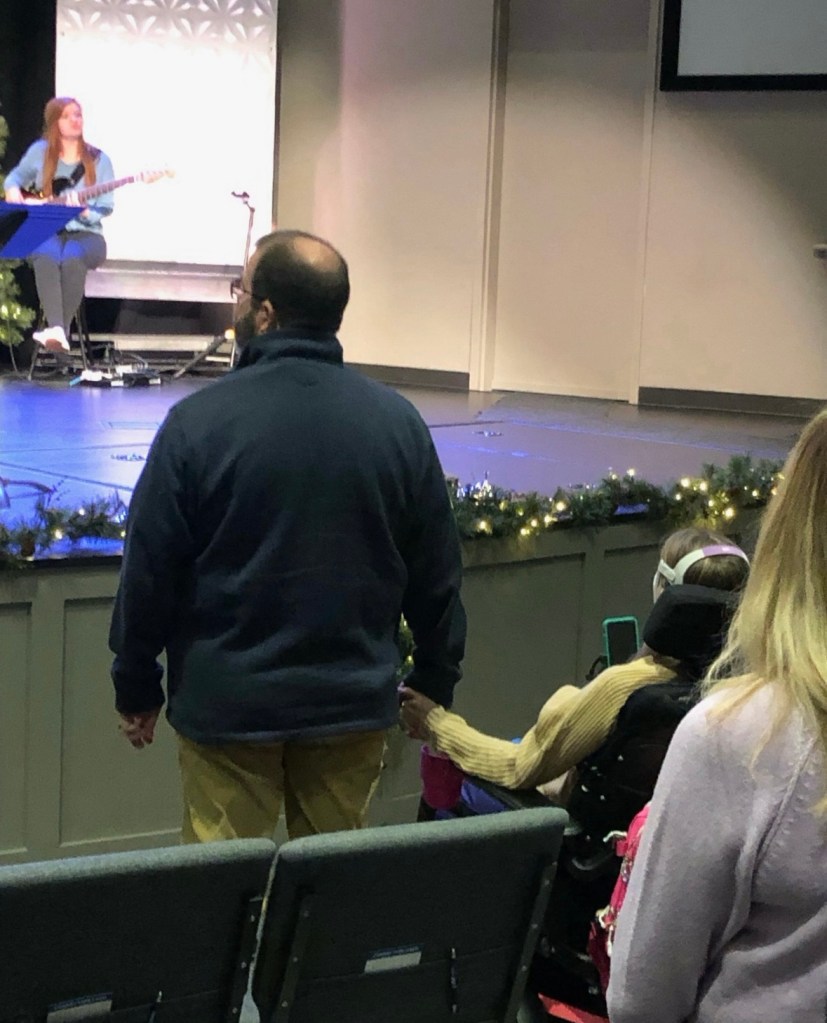
The girl continued to push herself to be there, sometimes through difficult obstacles. A wheelchair ramp that often did not work. A car door that jammed half the time. But instead of resolution, she had to soldier on in the best way she could, piecing things together to work so she could still show up.
Being in that place made her come alive, surrounded by likeminded friends journeying together. Eventually though, even that got too hard in a body that was fighting against her in every way.
When she tried to use her gifts in the ways she still could, she was nothing more than an inconvenience. Where her phone used to light up if she left a vacancy in the front row, it now sat gray and silent, as if the empty space had simply backfilled in her absence.
She hoped that the community she worked hard to build around her would continue to surround her in this new season and new capacity, but things grew quiet.
The walls of her room that used to echo with presence and laughter now felt more like walls of a prison, as visits became fewer and further between. Still she clung to the hope that her heart and her home would be full as she journeyed toward Home. Then came the realization that this road was going to end just as lonely as it had begun.
But that wasn’t the whole truth—just the part she could see.
Because somewhere along the way, she had quietly started measuring love by footsteps and phone calls… by who showed up and who didn’t. And while those absences were real and painful, they were never the full accounting of her life.
What she couldn’t always feel—but had not lost—was presence.
Not the loud, bustling kind that fills a room on a Sunday morning. Not the kind that depends on functioning ramps or willing friends. But the steady, unrelenting presence of a God who does not require her to “get there” in order to be near.
In the stillness of that room, where the walls sometimes felt too close and the silence too loud, there was Another who had never once failed to enter in.
The One who saw every effort it took just to show up.The One who noticed when no one else did. The One who did not measure her faith by attendance, but by endurance.
And maybe—though it took time to admit—her life was not a story of abandonment, but of being held in ways she didn’t expect.
Because the truth is, community can falter. People can disappoint. Even the most well-meaning hearts can drift when life gets busy or uncomfortable or unfamiliar.
But God does not drift.
He sits beside hospital beds and wheelchairs. He remains when invitations stop coming. He speaks in quiet when the noise of life fades.
And He does not wait at the finish line—He walks every inch of the road. So while it may have looked like her story was ending the way it began, heaven would tell it differently. It would say she was never unseen. Never unsupported. Never alone.
It would say that every hard step she took toward Him that felt unseen mattered more than a hundred easy ones taken in comfort.
And it would remind her—gently, faithfully—that “home” was never something she had to gather people to reach. It was always where He was. And He had been there all along.
When I opened my arms wide to welcome in a community that would keep us afloat on the days we need it, and hold us up on the days we are too frail, I also opened my arms to a whole range of perspectives, experiences, and opinions. It stands to reason that with so many different brush strokes making up my tribe, there will sometimes be tension when considering my situation.
I am a terminally ill young(ish) mom, wife, medical professional, friend, and relative with an awful lot of people who care deeply about me and want the best for me. And each of those “best wishes” is shaped by that person’s own knowledge, fears, and life experiences. I’m genuinely grateful for that—it means no stone is left unturned, no possibility ignored, no concern left unspoken. That kind of care is a gift.
But if I’m honest, it can also be a lot to carry.
I have been offered the full spectrum of doctors’ names and specialties, an impressive number of healing stories shared from personal experience, and a wide array of remedies that are “sure to help”—from expensive teas and elaborate oils to unconventional rituals and everything in between. Each suggestion is given with love. I know that. I feel that.
And still… it can be overwhelming.
Because underneath all of it is an unspoken assumption: that I might not be doing enough, considering enough, or protecting myself well enough.
The truth is, I am living inside this body every single day. I am the one weighing the risks, measuring the energy costs, and deciding what is worth it and what is not. I am constantly calculating—what will give me more life, and what will simply take more from me.
I need the space to do that.
I need the freedom to say, “Thank you, but no,” without feeling like I am letting someone down or missing something critical. I need permission—not from others, but from myself—to trust my own judgment.
Because I am not passive in this. I am not unaware. I am not neglecting my care.
I am choosing, very intentionally, how I spend what I have.
Sometimes that will look like pursuing treatment. Sometimes it will look like resting. Sometimes it will look like saying yes to something that feels worth the risk, and other times it will look like protecting my peace at all costs.
All of those choices are valid.
So if you are someone who loves me—and I know you are—please hear this gently: your care means everything to me. Your suggestions come from a place of compassion, and I don’t take that lightly.
But the most supportive thing you can offer me is trust.
Trust that I am listening.
Trust that I am thinking.
Trust that I am choosing with both wisdom and intention.
And trust that I know, better than anyone else, what my body and my life require in this season.
Walk with me. Sit with me. Pray for me. Laugh with me.
But please, let me lead when it comes to my own limits.
Someone recently asked me what my favorite tangible thing is. It gave me pause, because I don’t think I’ve stopped to wonder over that question, but the answer was clear. My pink journaling Bible.
It’s hard to explain, but my pink art journaling Bible isn’t just a book to me—it’s the place where my life with God has actually taken shape in a visible, tangible way.
Every page holds more than printed words. It holds prayers I’ve prayed when I didn’t have the strength to say them out loud. It holds questions I’ve wrestled through, verses that steadied me, and moments where something finally “clicked” and I knew God was speaking to me personally. The notes, the colors, the artwork—they’re not decoration. They’re a record of relationship.
Over time, it’s become a kind of memorial. I can flip back and see where I was struggling, where I was growing, and how God met me in those exact places. It reminds me that He’s been faithful, not just in general, but to me—specifically, consistently, and patiently.
It’s also one of the few places where I’ve been completely honest. No performance, no editing—just me showing up as I am. That makes it deeply personal in a way that’s hard to replicate anywhere else.
So when I say it’s my favorite tangible object, it’s not about the Bible itself being pink or artistic—it’s because it carries the history of my walk with God. It’s worn in all the right ways. It’s lived in. And it reminds me who He is, and who I am in Him.
If you watched my video this week about getting new glasses, you undoubtedly noticed its lighthearted tone . I try to add an underscore of humor to all of my videos there, since the goal is education and awareness about MSA, not to garner pity or sad feelings from people. In reality, this latest change for me has been a little more heavy than humorous.
It started when I noticed my vision had pretty rapidly gotten very blurry. I wondered if it was a side effect of one of my medications, or if the slight glasses prescription I already have needed to be updated. When I went in for an eye exam, I learned it was neither. The reason for the profound vision loss I was experiencing was because my disease has weakened the muscles controlling my eyes so much that the blurriness I have been noticing is actually me seeing double.
The doctor that saw me that day was so compassionate and kind-hearted; I could tell he truly cared about my situation and wanted the best outcome possible for me. I sat staring through the giant robot-thingie while he dialed in lens after lens, trying to make it strong enough to correct my vision. It got better— the two birthday candles that started a few hand widths apart from each other moved in closer and closer, but even at top strength the candles never merged into one.
So I left the office with a new pair of thick bifocal glasses, feeling very much like the rug had been yanked out from under me by this new development that had not even been on my radar. And truth be told, even with my new specs there is a lot that has been lost as far as what I can see in detail, which in turn affects what I can do.
It was a disheartening blow at first, that left me wondering what I had to offer now. My Etsy business would be affected, my art, my writing… what was left for me to give to the people I love and care about?
For a little while, my mind went to the same place it always used to go when something was taken away from me: What am I still useful for?
Illness has a way of asking that question over and over again. Every new limitation feels like another subtraction sign—another thing crossed off the list of what you once could do.
And if I’m honest, I realized something in the middle of that discouragement: somewhere along the way, I had quietly started believing that my value to God and to other people was tied to my abilities. My productivity. My output. What I could make, build, write, organize, or contribute.
But that has never actually been the way God works.
God never needed my abilities.
He never needed my Etsy shop, or my artwork, or my words, or my capacity to juggle responsibilities and keep producing things that look impressive on the outside. None of those things were ever the offering He was asking for.
What He wanted was always much simpler—and much harder.
He wanted my heart.
When I started reading through Scripture again with this in mind, it was everywhere. Over and over, God makes it clear that He is not impressed with human strength or skill. In fact, He seems to go out of His way to work through weakness.
He chose shepherd boys, stutterers, widows with two coins, fishermen with no education, and people who openly admitted they were afraid and inadequate. Again and again, God reduced the resources so that no one could mistake where the power came from.
Which means my declining abilities are not a surprise to Him.
They don’t disqualify me.
If anything, they strip away the illusion that I ever had something impressive to bring to the table in the first place.
The truth is that my offering was never supposed to be what I could do.
My offering was always supposed to be me.
My trust.
My willingness.
My obedience in whatever small space I’m given today.
The older I get and the more this disease takes, the more God keeps narrowing things down to that single point: Will you still give me your heart when the things you used to rely on are gone?
And the surprising thing is that there is actually a lot of freedom in that question.
Because if God only wanted my abilities, I would eventually fail Him. Bodies break. Energy fades. Vision blurs. Talents come and go.
But if what He wants is my heart, that is something illness cannot take away.
Even on the days when my eyes won’t cooperate, when the candles refuse to merge into one clear image, when I can’t do half the things I used to do… I still have something to give.
I can still choose to trust Him.
I can still choose to love people well.
I can still offer the small, quiet faithfulness of a life surrendered.
And maybe that was the lesson hiding inside this unexpected trip to the eye doctor.
My vision may be fading in ways I never anticipated.
But in a strange way, the picture itself is becoming clearer.
If you watched my video this week about getting new glasses, you probably noticed the lighthearted tone. I try to keep humor woven into my videos because the goal is education and awareness about Multiple System Atrophy (MSA)—not to make people feel sorry for me.
But the truth is, this latest change has felt a little heavier than humorous.
It started when I noticed my vision had gotten blurry very quickly. I wondered if it might be a side effect of one of my medications, or maybe my slight glasses prescription just needed updating. When I went in for an eye exam, I learned it was neither.
The reason for the vision problems was that my disease has weakened the muscles that control my eyes. The blurriness I was experiencing wasn’t actually blur at all—it was double vision.
The doctor who saw me that day was incredibly kind and compassionate. I could tell he genuinely cared about what I was facing and wanted the best outcome possible for me. I sat there staring into the giant robot-looking machine while he dialed lens after lens into place, trying to make the prescription strong enough to correct my sight.
It got better. The two birthday candles that started several hand widths apart slowly moved closer and closer together. But even at the strongest setting… they never merged into one.
I left the office with a pair of thick bifocal glasses and the unsettling feeling that the rug had just been pulled out from under me. This development hadn’t even been on my radar. And the truth is, even with the new glasses there is still a lot that has been lost in terms of what I can see clearly—and that affects what I can do.
At first it was a discouraging blow. My Etsy business could be affected. My art might be harder. My writing could become more difficult. I found myself wondering a question that probably sits quietly in many of our hearts at one time or another: What do I have to offer now? When our abilities begin to shrink, it’s easy to feel like our usefulness is shrinking too. Our culture trains us to believe that our value lies in our productivity, our skills, our accomplishments, and the things we create.
But the longer I walk this road, the more I realize something important: God has never asked me to offer Him my abilities. He has always asked for my heart. In the Old Testament sacrificial system, people brought offerings to the altar—animals, grain, oil, wine. But even then, God repeatedly reminded His people that the physical offering wasn’t the thing He truly desired. He wanted their hearts. Scripture says that “a broken and contrite heart… you will not despise.” (Psalm 51:17) In other words, the offering God values most is not what we produce, but who we surrender.
That realization has been quietly reshaping the way I think about loss. If my art becomes harder… I can still love people. If my business slows down… I can still encourage someone. If my vision fades further… my heart can still belong completely to God. None of those things require perfect eyesight, steady hands, or impressive talent. They simply require willingness.
So maybe the question isn’t “What do I still have to offer?” Maybe the real question is, “Am I willing to place my heart on the altar?” Because that offering never becomes obsolete. It never weakens with disease. It never diminishes with age or limitation. And it is the one offering God has always wanted most. So, if your abilities feel smaller than they used to… if illness, loss, or circumstances have taken things from you that you once used to serve others or serve God… take heart. Your most valuable offering has never been your strength. It has always been you.